
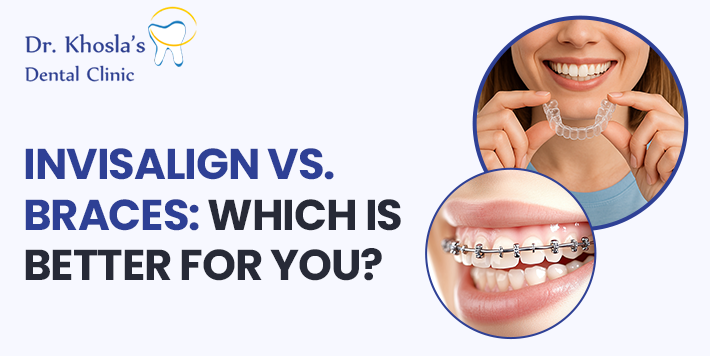
If there’s one unsung “valuable” asset that redefines your beauty and personality, it’s your smile. Sporting a straight, confident smile is not just about aesthetics; it also signifies good oral health, confidence, and long-term functionality.
But what if you are saddled with malaligned teeth? Should you opt for traditional braces or a more modern solution, such as Invisalign or clear aligners? The question naturally arises: Which is better for me—Invisalign or braces?
The truth is, the “better” option depends entirely on your needs, goals, and lifestyle. Hop on and scroll down as we explore the details in this guide from Dr. Khosla’s Dental Clinic.
What Are Braces and Invisalign?
Before we make choices, let us clarify the basics. What are braces, and what is Invisalign?
Traditional braces
This is the “go-to” choice for correcting malaligned or crooked teeth, and they have been for decades now. They are made up of metal or ceramic brackets attached to each tooth, connected by wires and elastic bands. You will meet with your orthodontist for follow-up check-ups, where they will periodically adjust these wires to guide your teeth into proper alignment.
https://www.school.ojsat.or.th/
The prominent types of braces include:
- Metal braces
- Ceramic braces
- Lingual braces
So, how do they work? Braces exert continuous pressure on the teeth, slowly shifting them into position. What’s great about them is that they work to fix many dental complications, such as crowding, gaps, overbites, underbites, and even severe jaw malalignments.
Invisalign
The second choice for correcting your malaligned teeth is Invisalign or clear aligners. These are custom-made, transparent aligner trays crafted from smooth, BPA-free plastic. These trays fit snugly over your teeth and are replaced every 1–2 weeks to shift your teeth into the desired position gradually.
During your consultation, our orthodontist at Dr. Khosla’s Dental Clinic will first perform a 3D digital scan of your teeth and then design the next steps in your treatment plan.
Invisalign vs. Braces: How Do They Compare?
Now that you have a brief overview of what traditional braces and Invisalign are, let us compare these two side by side to determine which would be a better fit for correcting your teeth’s crookedness or malalignment.
| Feature | Invisalign | Traditional Braces |
| Appearance | Nearly invisible | Visible (metal or ceramic) |
| Comfort | Smooth, no irritation | May cause gum or cheek discomfort |
| Oral Hygiene | Removable, easy to clean | Food can get trapped and https://adminpg.foreigners.bu.edu.eg/ requires careful brushing |
| Diet Restrictions | None (remove during meals) | Avoid hard/sticky foods |
| Maintenance | Requires discipline to wear consistently | Always on, no need for compliance |
| Treatment Range | Mild to moderate cases | Mild to complex cases |
| Follow-up Visits | Fewer, every 6–8 weeks | Regular, every 4–6 weeks |
| Treatment Time | 6–18 months | 18–36 months |
| Aesthetics | Virtually invisible | Noticeable |
| Cost | Generally higher | More economical |
Now, if your mind is stuck with the question, “So, which one would be a better fit for me?” Well, that, in particular, is determined by our orthodontists during the consultation. We will not only assess the degree of malalignment but also / consider other factors, such as jawbone, oral, and systemic health, before determining the best treatment plan for you.
Effectiveness: Which Works Better?
The answer to that is quite subjective. And before you think it is a diplomatic answer, well, that’s not necessarily the case. Let’s explain it better.
If you have severe orthodontic issues where it’s affecting your ability to chew food or speak clearly, traditional braces are non-negotiable. Once your teeth are better aligned after using braces, only then would you be an ideal candidate for getting clear aligners.
The thing about traditional braces is that they provide precise control over tooth movement and are ideal for patients who require extensive correction.
Invisalign, on the other hand, excels in mild to moderate cases, such as minor spacing, crowding, or simple bite corrections. However, with advances in dentistry, even Invisalign is becoming more functional and practical for handling more complex cases.
At the end of the day, the “effectiveness” of the orthodontic treatment starts with your consultation and assessment. Our dentists at Dr. Khosla’s Dental Clinic perform digital imaging to determine which option offers the best possible outcome.
What is the Cost and Investment for Braces and Invisalign?
Another factor to consider when choosing between “braces or Invisalign” is cost. How much would you need to spend on them, and what are the ongoing and maintenance costs?
The cost of braces usually starts from ₹25,000 to ₹50,000 for metal braces, ₹40,000 to ₹70,000 for ceramic braces, or ₹80,000 to ₹1,20,000 for lingual braces.
On the flip side, the cost of Invisalign or clear retainers starts from ₹1,50,000. On the higher end, the price of the treatment can reach ₹3,50,000, depending on how severe the condition is, how much refinement is required, and whether extra procedures are needed.
So, while Invisalign is more expensive upfront, many people find the additional cost justified by its comfort, aesthetics, and, in some cases, shorter treatment time for moderate cases. However, for severe cases, braces may provide more predictable movement at a lower cost.
Duration of Treatment: How Long Will It Take?
Up next on the checklist is the duration of the treatment. “How long will I have to wear them?” is a recurring question many of our patients ask at Dr. Khosla’s Dental Clinic.
Every mouth is unique, so treatment time varies. However:
- Invisalign: Usually 6–18 months
- Braces: Typically 18–36 months
For the most part, Invisalign is recommended for “simpler” cases with mild crookedness or complexity, which is why the treatment duration is shorter.
However, for more complex orthodontic needs, braces may deliver more predictable and thorough results over a more extended period.
What’s great about our orthodontists at Dr. Khosla’s Dental Clinic is that we provide a digital timeline of your treatment so you can visualise how your smile will evolve month by month. Sounds exciting, doesn’t it?
Your Smile, Your Choice Guided by Experts!
When comparing Invisalign vs. braces, both options have their strengths. Braces are time-tested, versatile, and ideal for complex corrections. Invisalign, on the other hand, brings modern convenience, superior comfort, and unmatched aesthetics.
Let our orthodontists at Dr. Khosla’s Dental Clinic guide you through the decision with a personalised consultation.
Please book your appointment today or call us at +91-87663 86694 | +91-92897 36852 to discuss your options.